Asher Bezdek: The City We Keep Painting Over

It’s a weird feeling, driving around Los Angeles and having nostalgia for a time I’ve never lived in. I first noticed my discomfort on Pico Boulevard, when I passed the tutoring center where I’d learned to read and write. At five, the bright yellow building had been a place of hope for me. Then one day it was painted gray: blandified. Like that, my attachment felt harder to reach. I felt it again after Patrick’s Roadhouse closed in 2024. I’d driven past the diner near Pacific Coast Highway my entire childhood. Its bright green exterior and roofline crowded with knights and dinosaurs looked like something a kid might dream up. Inside were paintings, memorabilia, and well-worn wooden benches from an old train station. When the green gave way to dull blue and the statues disappeared, a familiar landmark became a building I could easily pass without noticing.
Was it me, or was Los Angeles getting blander? Passing another gray McDonald’s, I kept asking, “Who wanted this?” I turned to Google Street View, comparing buildings along La Cienega Boulevard in 2009, a year after I was born, with the same stretch in 2025. In my informal survey, the share I classified as neutral-colored rose from about 72 percent to 94 percent. It wasn’t a citywide study, but it gave shape to something I’d been feeling.
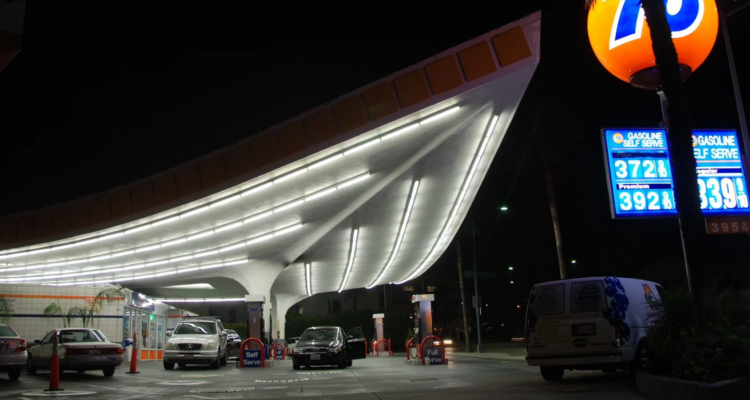
That made the Beverly Hills 76 station even more captivating. My mom used to point it out from the car. Rows of lights follow a canopy that sweeps above the pumps like a spaceship preparing to land. Architect Gin Wong designed it in 1965, originally as part of LAX Airport; it eventually found its home in Beverly Hills. Back then, even getting gas apparently deserved a little wonder.
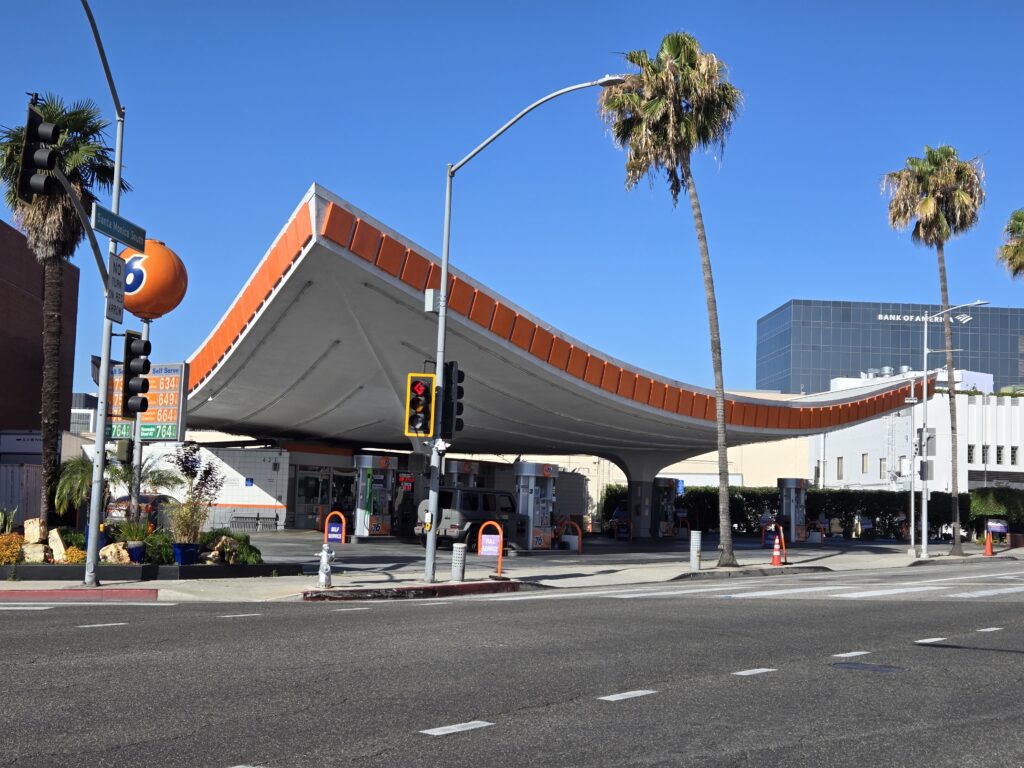
I learned that the name for this style was Googie. Its angled roofs, plate-glass walls, and exuberant signs helped define postwar Los Angeles. Built overwhelmingly between the late 1940s and the mid-1970s, these highwayside buildings were designed to catch a driver’s eye, then draw that person inside. Fifty years ago, thousands of Googie buildings lit up the Los Angeles cityscape. Fewer than 30 remain today.
To understand the history of these buildings, and what happened to them, I began photographing the last survivors. After enough diner meals, though, I realized I wanted to know more than what they looked like. I wanted to know what transpired within them, to assemble a record asserting the value of preserving these buildings while we can.
That desire led me to Bob Shayne. I crumpled my sheet of questions as he led me into his Westside apartment. Wet from the rain, I hauled cameras, microphones, and tripods up steep wooden stairs, the kind that make you suspect a grandfather clock must be nearby. With his white beard, wire-frame glasses, and slightly unruly silver hair, the retired screenwriter seemed comfortably at ease. He also seemed amused that a teenager would bring so much equipment to capture a record of his childhood.
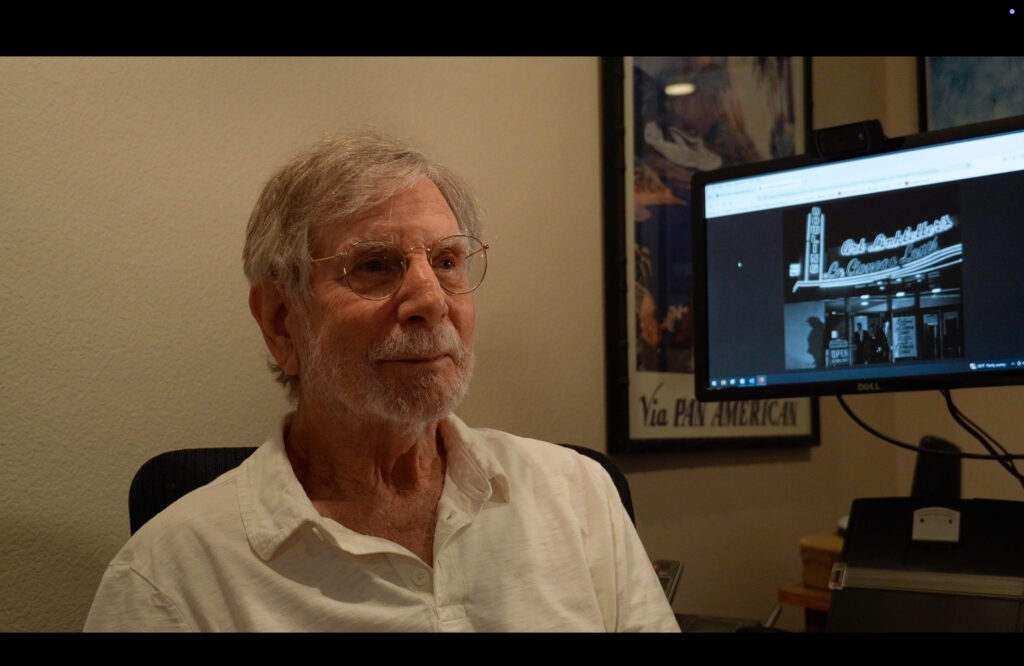
“More gear than any one person would need,” he said. I’d found him in the comments beneath a blog post by Martin Turnbull about La Cienega Lanes, a bowling alley at Santa Monica Blvd. and La Cienega Blvd. Bob had corrected the dates of its purchase and sale: his father had been a partner. In the photographs, neon lettering stretched above a glassy entrance, beside a tall vertical BOWLING sign. The building opened in 1940, before Googie’s postwar heyday, but its streamlined curves shared the roadside exuberance that had drawn me to the style.
Bob’s family had moved from New Jersey to Los Angeles after his father, Joe, developed a heart condition and was advised to avoid shoveling snow. Joe eventually ran the alley with partners including television personality Art Linkletter. Linkletter’s name went on the sign; Joe handled the daily work.
As a kid, Bob spent summers handing out shoes, taking cash, and helping in the office while his father read the newspaper. He seldom bowled. One memory he recalled vividly was typing the café’s daily specials and spelling chicken-fried steak as “stake.” He’d clipped the slips to every menu before someone caught it. Then he had to type them all again.
Did he feel nostalgic for La Cienega Lanes? I wondered.
When I asked him about La Cienega Lanes’s eventual fame as a 1970s gay hotspot, he admitted he hadn’t known West Hollywood was a gay area until embarrassingly late—seeming to suggest that he viewed this popularity primarily as an accidental windfall. When I asked about his father’s relationship to, and partnership with, Linkletter, he shrugged. The bowling alley was “more memorable, I guess, with a star’s name in it.”
Time and again, questions I’d hoped would spark reminiscences led to conversations about economics. And economics, too, brought this era of Shayne’s childhood to an end. When partners at La Cienega Lanes considered installing automatic pinsetters, engineers found too little room behind the lanes to install the new technology. Moving all twenty-two lanes forward would have been prohibitively expensive. So the partners sold.
A practical problem led to a practical decision.
The more we talked, the more I wrestled with feelings of disappointment. And as I reviewed footage of our conversation, I realized I’d been expecting Bob to validate a story about the importance of preservation I’d already devised.
I wanted him to mourn La Cienega Lanes, to tell me that Los Angeles had lost something irreplaceable. Instead, he remembered work, people, and an embarrassing spelling mistake. The building itself seemed almost incidental.
Dishearteningly, his testimony seemed to justify a remark I’d stumbled upon from architect Eldon Davis, whose firm Armet & Davis helped define Googie. Davis himself had been surprised at efforts to preserve his coffee shops. According to the Los Angeles Conservancy, his design principle had been practical: sell food.
Maybe I had glamorized the past, which had been no less driven by profit than our blandified present. But then I began to wonder whether a building has to feel historically important to the people using it to become important later. Almost nobody spends a summer handing out bowling shoes thinking the place should be preserved for someone seventy years in the future. That is what makes ordinary places so easy to lose.
Besides, building for simple commercial purposes need not—and historically did not—exclude imagination. In a separate statement, Eldon Davis had said so too. As he told the Los Angeles Times in 1993, in designing Googie buildings, “We didn’t want to do what had been done.”
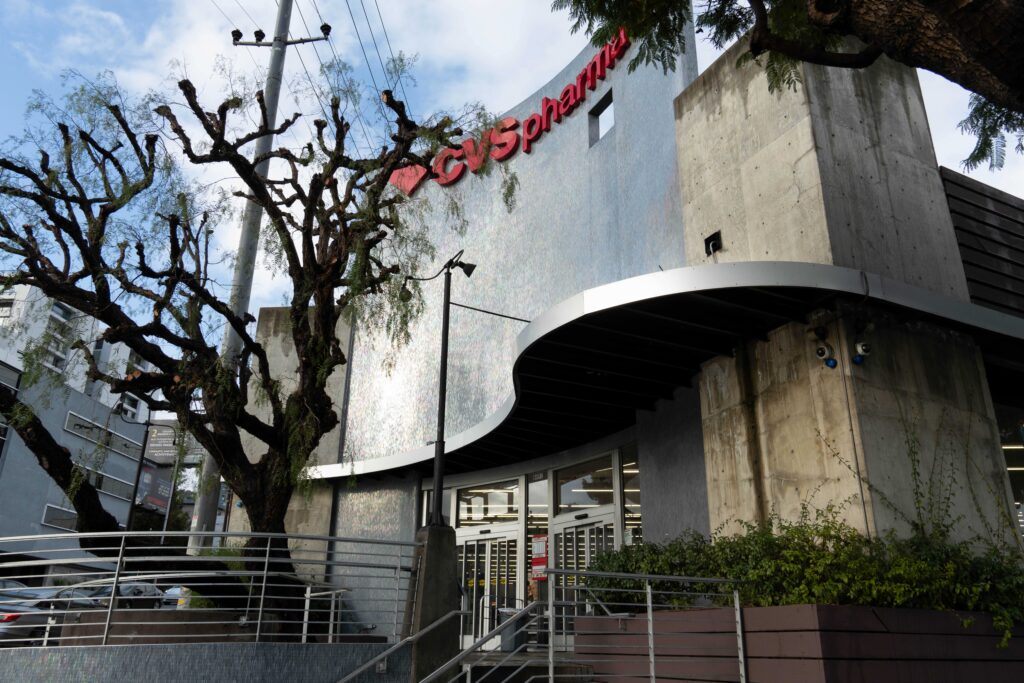
That stayed with me. These places were built to make money, yet their designers used genuine imagination to do it. Bobby Green, a designer who restores historic Los Angeles spaces, described the city to me as a whiteboard: build something, wipe it clean, begin again. What happens when we keep the habit of erasing but lose the willingness to draw? La Cienega Lanes itself kept changing. It became Flipper’s roller rink in 1979, then an Esprit store, and later a pharmacy. Each version held somebody’s evenings, friendships, and first jobs. Its history makes a case for allowing buildings to change while leaving enough of their earlier lives visible for someone to ask a question.
I still miss the yellow tutoring center. But Bob helped me understand that what I want to preserve goes beyond a particular color, decade, or even style. I want to preserve a presumption that ordinary buildings can, and should, be bold, because what we construct today won’t be erased tomorrow. If buildings are viewed as expendable from the start, then we set ourselves up for an ever-increasing cycle of construction and demolition—meaning cheaper buildings, wasteful practices, and an increasingly blandified cityscape.
And then finally, there’s the question of nostalgia—less in connection to our own pasts than our ability to imagine each other’s. A familiar doorway can give a grandparent and a teenager somewhere to begin a conversation. A surviving sign can lead a man to suddenly recount a story of accidentally typing “stake.”
When facades become blank slates for the next tenant, our streets begin to look as though they could be anywhere. But this future isn’t inevitable. We can design new places with enough imagination that someone will care what happens to them. Los Angeles should keep making room for its next life. Yet we need to keep pushing for preservation and restoration to leave us something to recognize from the last one.