Place
Sturges House
Watch List
In recent years, the Frank Lloyd Wright-designed Sturges House has been experiencing neglect with no timeline for repairs.
Place Details
Address
Architect
Neighborhood
Year
Style
Designation
Property Type
Government Officials
Attributes
City
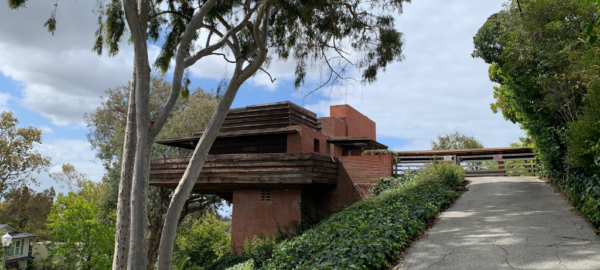
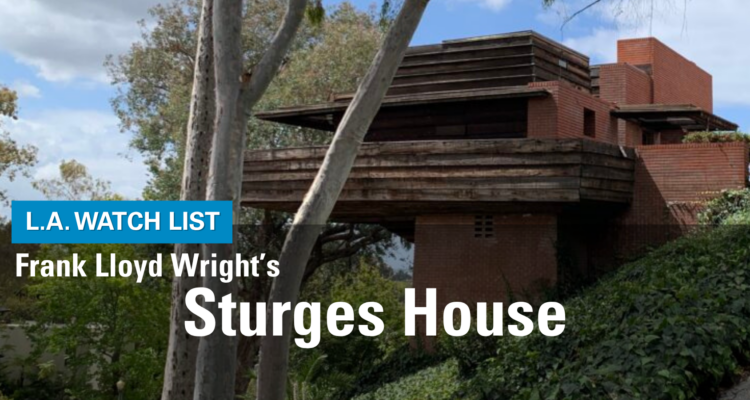
Sturges House, May 2026 | L.A. Conservancy Archives
Overview
The Sturges House, built in 1939 and designed by Frank Lloyd Wright, is located on a steep hillside in Brentwood Heights. The house represents an important piece of Los Angeles’ architectural heritage, and was listed as a Historic-Cultural Monument (HCM) in 1993. The home is now vacant, and at risk due to multiple years of neglect.
The Los Angeles Conservancy has identified the Sturges House as the first advocacy priority on its 2026 L.A. Watch List, an initiative highlighting endangered historic places across Los Angeles County. Each L.A. Watch List designation serves as a call to action, signaling a critical moment when timely public engagement can make a difference.
Thanks to the issues raised by the L.A. Watch List and requests from community members for enforcement, on July 1, 2026 the Los Angeles Department of Building and Safety (LADBS) issued a Notice of Code Violation to the property owner, followed by an Order to Comply on August 24, 2026. The Order gives the owner 30 days to achieve compliance with the building code or submit a plan to LADBS on how they will correct the issues.
About This Place
About This Place
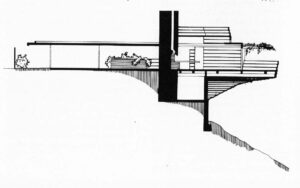
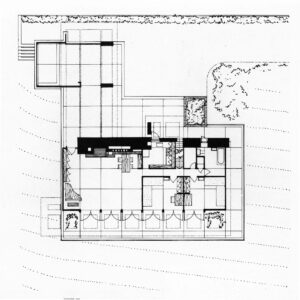
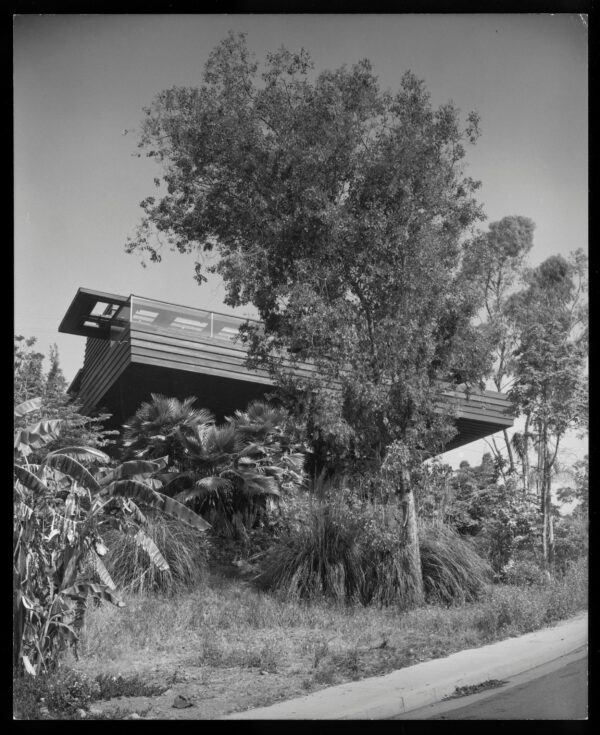
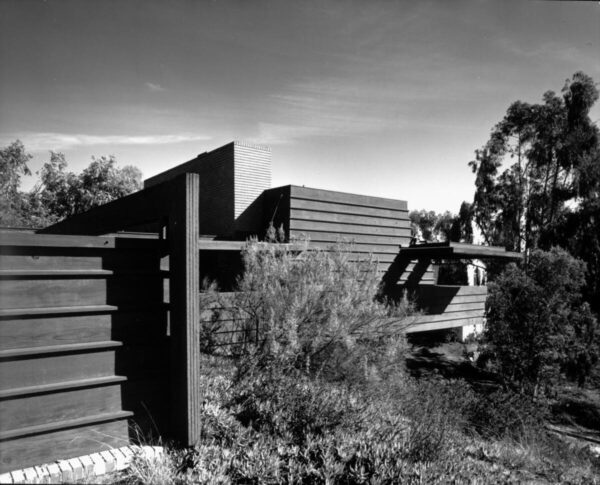
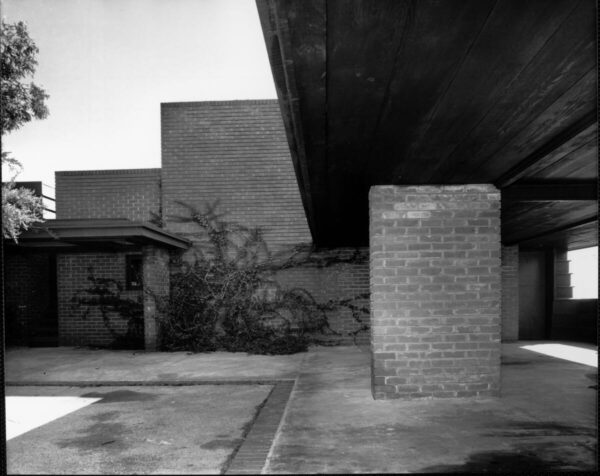
The Sturges House is a 1,200-square foot single-story rectangular pavilion with a living-dining room, two bedrooms, a kitchen, and one bath.[1] Parking is provided at the rear of the house in an open-air carport that is connected to the house by a breezeway. Its most striking feature is a 21-foot deck cantilevered over the canyon, its structural brackets clad in redwood siding to blend into the rest of the structure. A solid chimney anchors the uphill side while the living space projects out over the drop. The full material palette is brick, redwood, concrete, and steel.[2]
The Sturges House is one of the earlier examples of Wright’s Usonian-style type built anywhere in the country. Developed as a response to the economic pressures of the Great Depression, Usonian homes are defined by the use of local materials, focus on efficiency, and relatively small floorplans. The Sturges House was built two years after Wright completed Fallingwater in Pennsylvania. Both Fallingwater and Sturges House use extreme cantilevering to meet a difficult site and put the structure in direct conversation with the landscape. What distinguishes the Sturges house is its economy. The Sturges House achieves this at a fraction of the cost, a key tenet of Wright’s Usonian philosophy—his answer to what modern architecture could look like for middle-class Americans.
George and Selma Sturges were inspired by the January 1938 issue of Architectural Forum, devoted entirely to Wright’s work, and reached out to Wright to commission a house of their own. They wanted a version of the Jacobs House in Madison, WI—Wright’s pioneering Usonian from 1937. The Sturges’ purchased the lot in Brentwood Heights for $10 in September 1938, a steep hillside most would have considered unbuildable. Wright hired John Lautner to oversee construction, and the design was completed in 1939. In a letter with the plans for the Sturges House, Frank Lloyd Wright wrote to John Lautner “herewith sketches for the Sturges. It is one of the simplest things we have done and one of the best.”[3]
The Sturges’ lived in the home from 1939 to 1951, when they sold the house. Three separate owners held the property between 1951 and 1967.[4] That year, actor and writer Jack Larson and film director James Bridges purchased the house along with its Wright-designed furniture.[5] The couple were devoted stewards of the home for decades, commissioning Lautner to restore and maintain the property.[6]
Larson and Bridges were fixtures of the Los Angeles arts community, supporting emerging artists and building a collection of modern art that included work by Andy Warhol and David Hockney.[7] They were openly gay life partners and lived together in the Sturges house from 1958 until Bridges’ death in 1993. Larson continued to live in the Sturges House until his death in September 2015. He designated that proceeds from the sale of the house and art collection benefit the Bridges/Larson Foundation, which the couple had founded to support higher education, arts, and culture.[8] The house was listed with Los Angeles Modern Auctions in February 2016.[9]
Although the auction drew what the realtor described as “a thousand inquiries from around the world,” no qualified bidder registered to purchase and restore the property, and the house was withdrawn from sale.[10] It was subsequently acquired by the All Right Now Foundation 501(c)(3).
Our Position
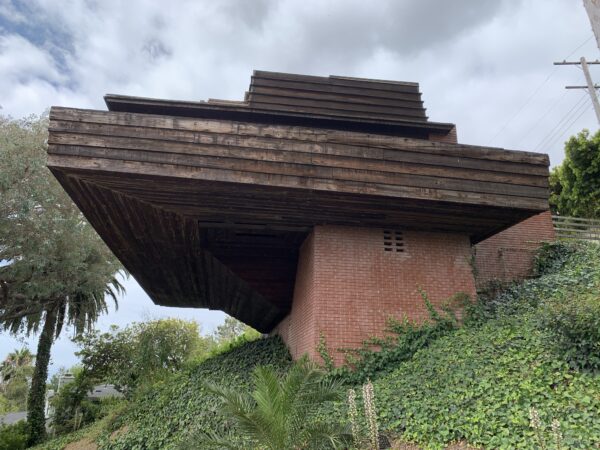
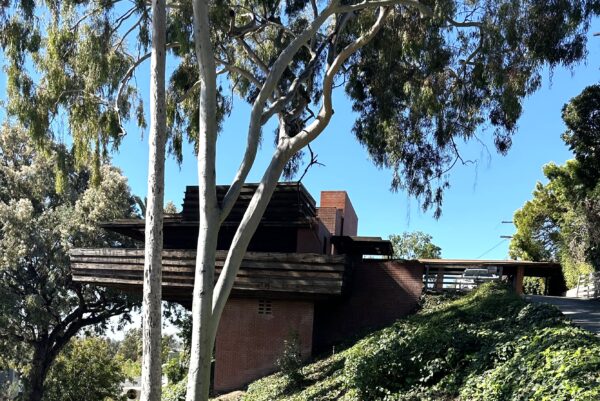
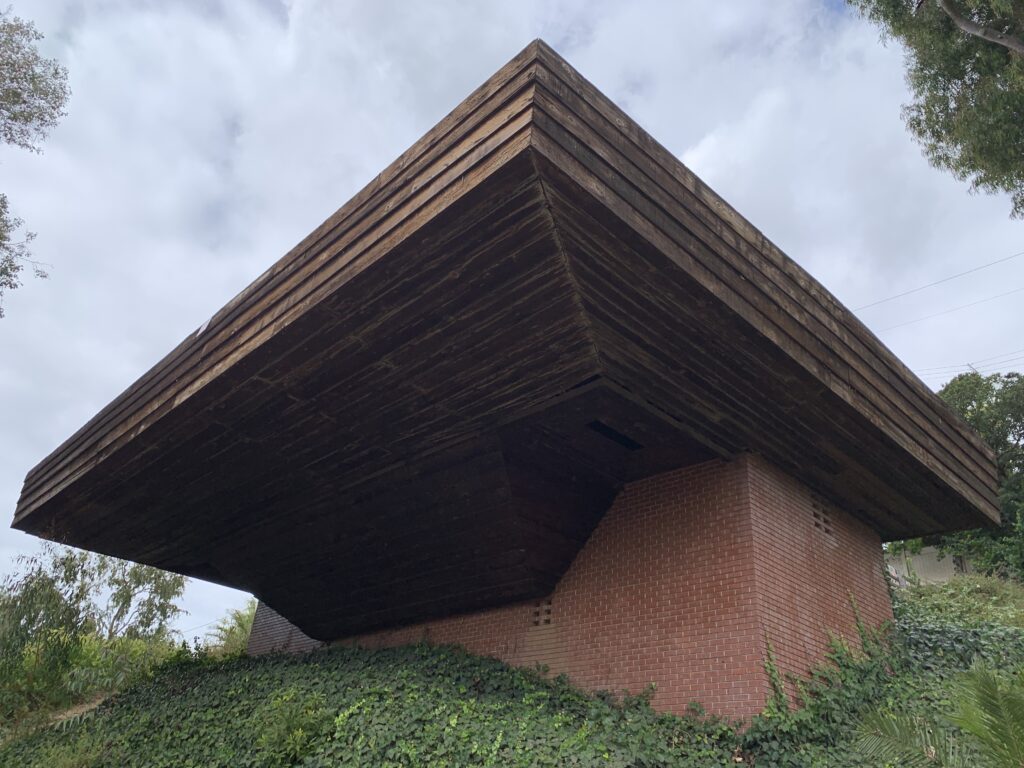 Recent visits by the Conservancy to the Sturges House show the house is in precarious condition.[11] The house sits deteriorating, and has for several years been a major concern for its neighbors. Decay of the original redwood has been observed from the street for some time. The long span of the carport is warped and its distinctive pillars are rotting. Visible open gaps in the siding leave the structure of the cantilever vulnerable, accelerating further damage to this designated Historic-Cultural Monument (HCM).
The Frank Lloyd Wright Building Conservancy is greatly concerned about the future of the Sturges House due to this deferred maintenance.[12] US Modernist confirms the situation is urgent in a 2026 newsletter describing the house as vacant and significantly deteriorating, with the cantilevered balcony in active decline.
“Demolition by neglect” is a term used when a historic property deteriorates through deferred maintenance until it suffers permanent damage or becomes structurally unsafe. At that point, demolition can be authorized as a public safety measure. While HCM designation provides some level of protection for the Sturges House, notably from alteration or demolition, ongoing neglect is more challenging given the City’s current lack of effective deterrents. In some cases, property owners have used demolition by neglect [see Barry Building] to their benefit, keeping historic places unsecured and degrading until they can receive approval for clearing a “nuisance” site – one that they have created.
Conservation easements are effective tools for protecting historic places in perpetuity. Easements are private agreements between an owner and a preservation entity, survive future changes in ownership, and allow designated organizations to enforce preservation standards. However, they require legal agreements set in place prior to a sale.
In 2016, the All Right Now Foundation, a 501(c)(3) nonprofit organization, acquired the Sturges House for the “purpose of preservation and education.”[13] The Manhattan Beach-based entity maintains this website for the Sturges House. The Los Angeles Conservancy and the Frank Lloyd Wright Building Conservancy have repeatedly reached out to the foundation regarding a preservation plan and a timeline for maintenance. To date, these efforts have been rebuffed.
How You Can Help
The Sturges House is not an isolated case of a historic place in need of care, as it reflects a systemic failure affecting historic places across Los Angeles. Unlike other cities, Los Angeles lacks a demolition by neglect ordinance. Property owners face no legal obligation to maintain historic resources, and the City has few mechanisms to require basic repairs. By the time code enforcement is possible, it is often too late and can be limited to demolition orders issued for public safety. Historic-Cultural Monument status alone cannot prevent ongoing neglect.
The Sturges House requires immediate intervention. Protecting it will take coordinated action across City departments—something the local council office is uniquely positioned to help lead. Thanks to the action by Councilmember Traci Park and her office, it appears the first steps towards enforcement have been made but not yet fully resolved.
At the same time, Los Angeles must adopt stronger, proactive protections to intervene earlier in cases like this. Contact Mayor Karen Bass and your City Council representative to support a local demolition by neglect ordinance or similar deterrents to help protect historic places. Without enforceable maintenance requirements, more of the City’s historic places will be at risk and potentially lost—not by intent, but by inaction.
Footnotes:
[1] City of Los Angeles Department of City Planning, Office of Historic Resources. 2017. “Hill Houses, 1920–1985.” Los Angeles Citywide Historic Context Statement: Architecture and Engineering, Technological Developments in Construction. July 2017. 18. https://planning.lacity.gov/odocument/c6f7f7ba-efc3-4ffd-8cc4-691ea56ba171/Hill%20Houses_1920-1985.pdf
[2] Ibid. 16-17.
[3] Sturges House. n.d. “About.” Accessed May 28, 2026. https://www.sturgeshouse.org/about.
[4] Sturges House. n.d. “Timeline of Sturges House Development.” Accessed May 22, 2026. https://www.sturgeshouse.org/sturges-timeline
[5] Ibid.
[6] Ibid.
[7] Chris Nichols.2016 “Superman Star Donates His Frank Lloyd Wright Home to Charity.” Los Angeles Magazine, Jan 6, 2016 https://lamag.com/architecture/superman-star-donates-his-frank-lloyd-wright-home-to-charity/.
[8] Frances Anderton “Storied Sturges House Seeks Loving Owner,” KCRW, February 9, 2016, https://www.kcrw.com/shows/design-and-architecture/stories/storied-sturges-house-seeks-loving-owner.
[9] Los Angeles Modern Auctions. 2016. “Lot 86: Frank Lloyd Wright, George D. Sturges Residence.” Modern Art & Design Auction, February 21, 2016. https://www.lamodern.com/auctions/2016/02/modern-art-design/86.
[10] Frank Lloyd Wright Building Conservancy, “Wright’s Sturges House Withdrawn from Auction,” 2016, accessed May 27, 2026, https://savewright.org/wrights-sturges-house-withdrawn-from-auction/.
[11] Conservancy representatives have conducted a series of site visits over the years with the most recent in May 2026. Photos taken from public right of way are included in the website page.
[12] John H. Waters, 2024. “Preserving the Work of Frank Lloyd Wright through the Use of Archival Materials.” APT Bulletin: The Journal of Preservation Technology 54, no. 3/4: 21–28. https://www.jstor.org/stable/48816882
[13] Sturges House. n.d. “Timeline of Sturges House Development.” Accessed May 22, 2026. https://www.sturgeshouse.org/sturges-timeline



Related Links
- “Historic LA home designed by legendary architect left to rot as wild animals spotted roaming inside,” California Post, September 2, 2026
- “Famous Frank Lloyd Wright home in L.A. is falling apart: report,” KTLA, September 2, 2026
- A Frank Lloyd Wright House in L.A. Is in Danger of ‘Demolition by Neglect,’ Say Advocates, Smithsonian Magazine, September 1, 2026
- “Frank Lloyd Wright’s Only Usonian Home in L.A. Is Falling Into Disrepair,” Artnet, August 28, 2026
- “Wright’s only Usonian house in Los Angeles is in such bad shape that it risks being demolished,” Domus, August 25, 2026