Place
Arzner-Morgan Residence
The first woman to join the Directors Guild of America, Dorothy Arzner was a pioneering director and one of early Hollywood's most prominent openly queer women.
Place Details
Address
Get directions
Year
Style
Property Type
Government Officials
Community
Overview
Home to Dorothy Arzner, the first woman to join the Director Guild of America, and her partner Marion Morgan, a prominent choreographer. Their home served as a refuge for other women and LGBTQ+ artists during the Golden Age of Hollywood.
About this Place
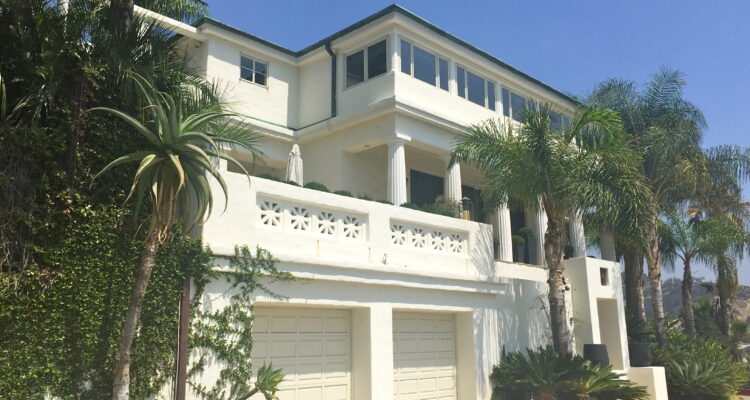
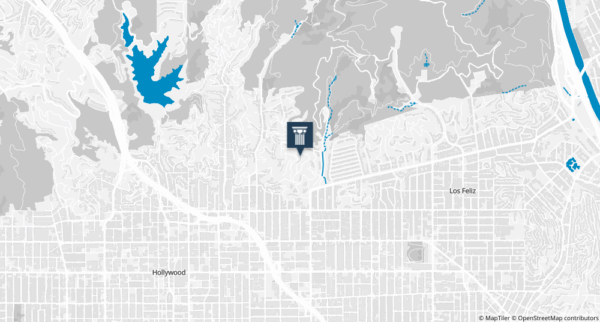
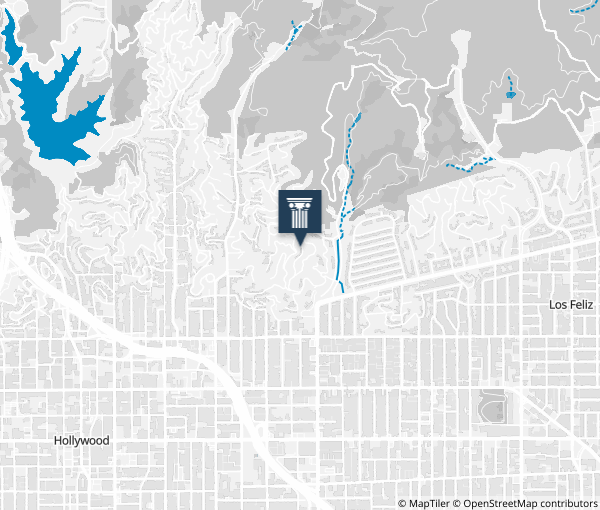
Between 1930 and 1951, this Greek Revival-style residence in Los Feliz was home to Dorothy Arzner (1897-1979) and Marion Morgan (1881-1971) during the most productive period of their Hollywood careers. Designed by W. C. Tanner, the Arzner-Morgan Residence was completed in 1930. The building was designated as a Los Angeles Historic-Cultural Monument (HCM) in 1986.
Dorothy Arzner was one of the most successful and well-known openly queer women in Hollywood of her time. She enrolled at the University of Southern California in 1919 as a medical student but quickly became disillusioned with the profession. Arzner then decided to pursue a career in the rapidly growing motion picture industry. She began her career at Paramount Pictures as a typist, script girl, editor, and screenwriter. Arzner director her first feature film – Fashions for Women – in 1927. Over the following two decades, she directed 16 feature films for major studios and became the first woman to join the Directors Guild of America.
Arzner’s career was defined by her insistence on centering women’s stories. She explored themes of women’s labor, friendship, and ambition, which challenged the representation of gender roles in most studio productions of the time. Examples include Wild Party (1929), Working Girls (1921), Christopher Strong (1933), and Dance, Girl, Dance (1940). Arzner’s artistic choices in her films mirrored her own personal defiance of Hollywood’s gender expectations; she often dressed in masculine attire and asserted her control over film sets. She later went on to teach film production at the Pasadena Playhouse and, in the 1960s, became the first woman to teach at the UCLA School of Theater, Film, and Television.
Arzner met Marion Morgan in the mid-1920s and formed a lifelong romantic and professional partnership. Morgan was a prominent figure in her own right. She started her career as a physical education instructor and drama teacher in California public schools after graduating from the University of California – Berkeley. She moved to Los Angeles in 1910 and started the Marion Morgan Dancers, an all-women dance troupe that combined interpretive dance with dramatic storytelling. The group was widely praised for its use of ensemble choreography and emphasis on women’s collective strength and grace.
In the 1920s, Morgan undertook contract positions in the film industry, working with Cecil B. DeMille to choreograph mass movement scenes and design costumes for films such as The Ten Commandments (1923) and The King of Kings (1927). After meeting Arzner, Morgan gradually withdrew from public touring and shifted her focus to developing screenplays and experimental performance work in Los Angeles. She also advised on dance scenes and staging for film productions.
The couple’s home on Mountain Oak Drive was more than their personal residence; it operated as a social space for other women and LGBTQ+ artists in Hollywood. The couple hosted emerging actors like Lucille Ball, Rosalind Russell, and Katharine Hepburn during screenwriter readings and performance workshops. Crucially, the residence offered a private social space for the LGBTQ+ community during a time when the film industry denounced homosexuality and enforced moral guidelines through the Hays Code.
The privacy of the Arzner-Morgan residence was carefully crafted through landscape design. In the 1930s, notable landscape architect Florence Yoch (of woman-led landscape design firm Yoch and Council) was commissioned to design the residence’s gardens. The Arzner-Morgan residence is one of Yoch’s lesser-known designs, but it reflects her approach to client-centered design. Original drawings reveal native stone retaining walls, terracotta-paved terraces, pergolas draped in wisteria, and shaded nooks designed for conversation and contemplation. The rear garden featured a small stage-like flat area, believed to have been used as an informal rehearsal space by Marion Morgan. The design not only helped launch Yoch’s career in Hollywood, but it also enabled Dorothy Arzner and Marion Morgan to live and entertain other women and LGBTQ+ artists in a private space.
Our Position
As a part of the Los Angeles Women’s Landmarks project – a partnership with the National Trust for Historic Preservation – the Arzner-Morgan residence is one of eight designated LA Historic-Cultural Monuments selected for an amendment to its historical narrative. This amendment is an important step forward in officially recognizing women’s contributions to Los Angeles’s cultural heritage and preserving places that reflect the City’s diverse histories. Only 2% of the 1,300 existing HCM nominations represent women.
The HCM process at the time of nomination did not require extensive historical research, and, as such, the 1986 designation does not properly recognize the full scope of women’s contributions to the site’s significance: the nomination primarily focuses on Dorothy Arzner. Through a partnership with the University of Southern California, Master of Heritage Conservation student Evan McAvenia identified the contributions of Dorothy Arzner, Marion Morgan, and Florence Yoch, as well as the residence’s significance to other women and LGBTQ+ artists in Hollywood. As such, the HCM record should be updated to reflect this history.
The Dorothy Arzner Morgan residence amendment is one of eight Historic-Cultural Monument (HCM) amendments advancing through the L.A. Women’s Landmarks Project. As the first HCM amendments undertaken in Los Angeles, they will establish a model for future amendment efforts.