Active
City of Los Angeles SB 79 Implementation
Active
The City of Los Angeles is currently considering options for the implementation of SB-79 legislation.
Overview
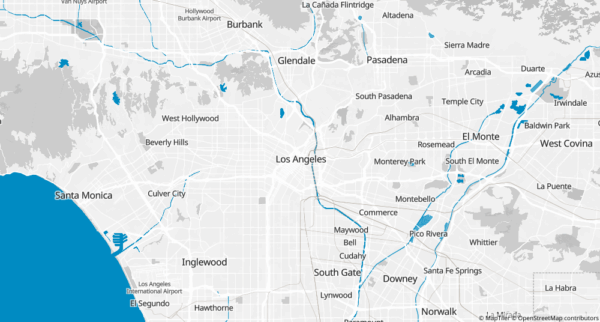
With the passage of Senate Bill 79 (SB 79), the City of Los Angeles has decided how to implement the new legislation. The law’s provisions are slated to go into effect July 1, 2026, but municipalities are given options to delay effectuation or create alternative plans of their own.
Los Angeles has directed City Planning to delay effectuation of the bill in all areas of the city, including within HPOZs, by expanding provisions of the Citywide Housing Incentive Program (CHIP) Ordinance. In 55 SB-79 stations, the Corridor Transition (CT), which allows missing middle typologies, will be expanded to single-family areas.
About This Issue
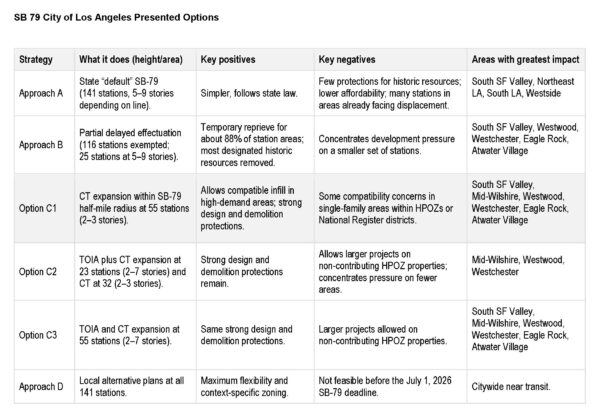
In November 2025, the Planning Land Use and Management (PLUM) Committee deliberated on how the City of Los Angeles should implement Senate Bill 79, the most contentious housing bill of 2025. City Planning presented four “approaches” for implementing SB-79. On February 24th, 2026, City Planning returned to PLUM with additional analysis and three “options” for Approach C that would create new development incentive areas in order to temporarily delay SB-79 citywide.
The PLUM Committee did not reach consensus on which option to pursue, but appeared most likely but forwarded the item to the full City Council without recommendation.
Since that meeting, public comment has largely divided into two camps. Some housing and anti-gentrification advocates generally support Option C3, which allows larger development at 55 “high opportunity” stations, while other housing and neighborhood advocates have coalesced around Option C1, which provides more modest incentives in those areas.
On March 24th, 2026 the City Council made a formal motion to pursue option C1, but explicitly excluded HPOZs from these added incentives.
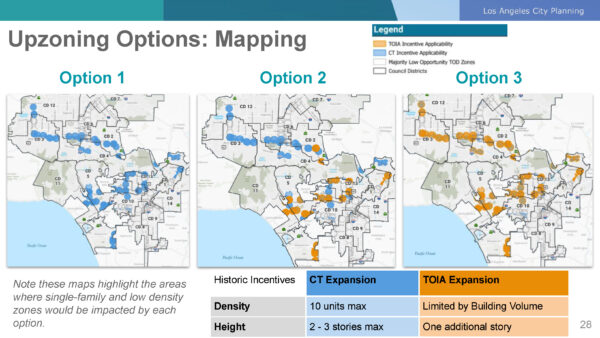
A slide showing the three Approach C options, L.A. Department of City Planning
Our Position
Based upon our analysis, the stark realities of SB 79, and community feedback, the Conservancy supports Option C1, with a key change: we strongly urge the City to exclude all HPOZs, regardless of when they were adopted. This more cautious approach better protects historic resources citywide, more evenly expands opportunities for compatible infill housing, and aligns with Los Angeles’ broader planning efforts, including ongoing Community Plan Updates in the San Fernando Valley and Westside.
At the same time, the Conservancy is working with our statewide partners to address the language of SB-79 itself, which includes arbitrary provisions—such as cutoff dates, percentage thresholds, and exclusion of CA and National Register historic districts – that will likely harm historic places over the long term. For this reason, we oppose any cutoff dates in the City’s implementation, including the 2015 cutoff for HPOZs.
Please read our letter to the City Council for more info.
Impacts of Approaches & Options
A quick guide to all six approaches is below. For additional information and interactive maps, please visit City Planning’s SB-79 Storymap.