Resolved
City of Los Angeles SB 79 Implementation
Resolved
The City of Los Angeles has adopted an innovative Low Rise Ordinance that will allow it avoid wholesale adoption of SB-79.
Overview
With the passage of Senate Bill 79 (SB 79), the City of Los Angeles was faced with a critical decision on how it would choose to implement the new legislation. The law’s provisions were slated to go into effect July 1, 2026, but municipalities were given options to delay effectuation or create alternative plans of their own.
Los Angeles’ City Council chose to delay SB 79 citywide until approximately 2030, but also adopted a targeted Low Rise Ordinance. This ordinance will allow the construction of 2-to-4 story multifamily buildings at over 50 station areas across the city, including areas that were previously single-family.
The Conservancy worked to ensure strong protections for historic resources in these ordinances, successfully advocating for an exemption for Historic Preservation Overlay Zones (HPOZs) and Historic-Cultural Monuments (HCMs).
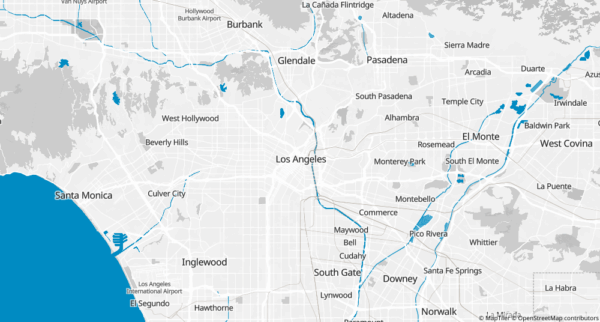
An interactive map of Low Rise eligibility is available here.
About This Issue
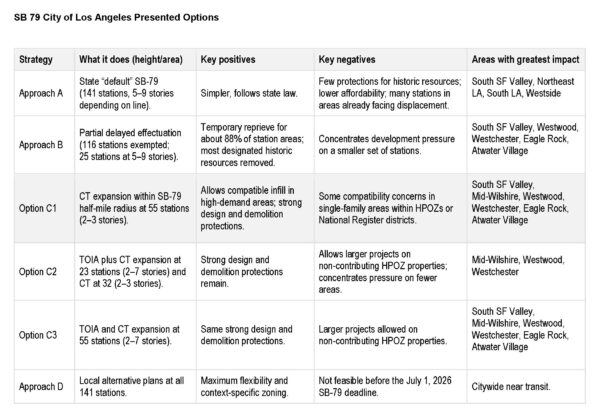
In November 2025, the Planning Land Use and Management (PLUM) Committee deliberated on how the City of Los Angeles should implement Senate Bill 79, the most contentious housing bill of 2025. City Planning presented four “approaches” for implementing SB-79. On February 24th, 2026, City Planning returned to PLUM with additional analysis and three “options” for Approach C that would create new development incentive areas in order to temporarily delay SB-79 citywide.
The PLUM Committee did not reach consensus on which option to pursue, but forwarded the item to the full City Council without recommendation.
Since that meeting, public comment was largely divided into two camps. Some housing and anti-gentrification advocates supported Option C3, which allowed larger development at 55 “high opportunity” stations, while other housing and neighborhood advocates coalesced around Option C1, which proposed more modest incentives in those areas.
On March 24th, 2026 the City Council made a formal motion to pursue option C1, but explicitly excluded HPOZs from these added incentives. The Council also passed motions aimed to update and amend the Corridor Transition Program, the zoning provision that Option C1 was modeled on.
In May 2026, City Planning released a new Low Rise Ordinance, which will update and replace the Corridor Transition Program. The new ordinance provides better incentives for projects containing family-sized units and better aligns to new state laws.
The Delayed Effectuation and Low Rise Ordinance, which work in tandem to delay SB 79 citywide while offering local alternatives in certain areas, underwent review by the City Planning Commission and by the Planning Land Use and Management (PLUM) Committees. In response to community concerns about compatibility, the Planning Commission recommended the ordinance provide larger rear setbacks for new Low Rise projects, increasing them from four feet to eight feet.
On June 3rd, the City Council approved the join Delayed Effectuation and Low Rise Ordinance approach, but then added some additional incentives for affordable housing. On June 30, 2026 both ordinances took effect.
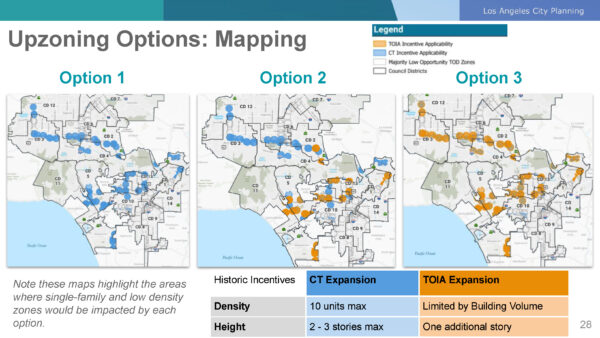
A slide showing the three Approach C options, L.A. Department of City Planning
Our Position
Based upon our analysis, the stark realities of SB 79, and community feedback, the Conservancy supported Option C1, with a key change: we strongly urged the City to exclude all HPOZs, regardless of when they were adopted. This more cautious approach better protects historic resources citywide, more evenly expands opportunities for compatible infill housing, and aligns with Los Angeles’ broader planning efforts, including ongoing Community Plan Updates in the San Fernando Valley and Westside.
We are pleased that this Option was selected by the City Council as the preferred approach.
The Conservancy spoke in support of the Delayed Effectuation and Low Rise Ordinances at multiple hearings through the adoption process. Under the proposal, HPOZs and HCMs would remain exempt from the Low Rise Ordinance expansion unless parcels were previously affected by CHIP’s Corridor Transition Program.
The Conservancy continues to work with our statewide partners to address the language of SB-79 itself, which includes arbitrary provisions—such as cutoff dates, percentage thresholds, and exclusion of CA and National Register historic districts – that will likely harm historic places over the long term.
Please read our letter to the City Council for more info.
Impacts of Approaches & Options
A quick guide to all six approaches is below. For additional information and interactive maps, please visit City Planning’s SB-79 Storymap.
Up-to-date information on the Low Rise Ordinance is available via the Council File.