Place
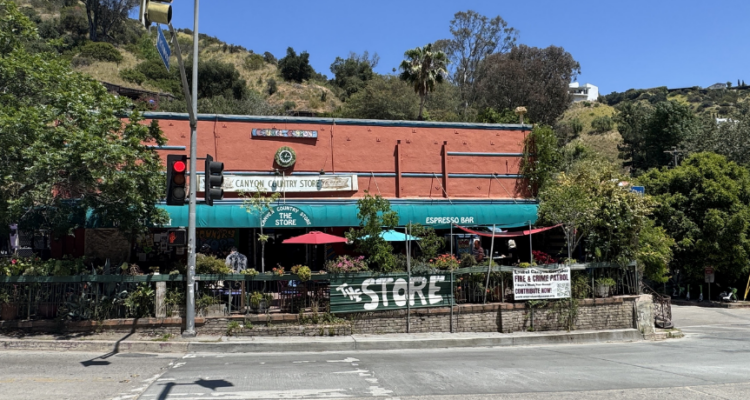
Canyon Country Store
Active
Great News! The Canyon Country Store was taken under consideration as a Historic-Cultural Monument on October 15th. We’re one step closer to landmark status!
Place Details
Address
Phone Number
Neighborhood
Year
Style
Property Type
Government Officials
Attributes
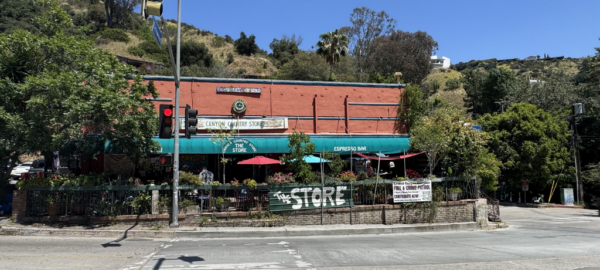
Canyon Country Store, April 2026 | Daniela Velazco/L.A. Conservancy
Overview
Nothing says Laurel Canyon quite like the Canyon Country Store. For generations, the Store has served as a neighborhood market and gathering place, fostering community in the canyon. During the 1960s and 1970s, the Canyon Country Store was at the center of Laurel Canyon’s legendary folk and rock music scene. As the canyon’s unofficial town square, the Store brought together musicians, artists, and residents during a formative era in American music.
Today, the Canyon Country Store continues as a beloved neighborhood market and neighborhood gathering space. When community members raised concerns about the Canyon Country Store’s ownership transition and future, the Conservancy partnered with local advocates to nominate the property as a Los Angeles Historic-Cultural Monument (HCM).
About This Place
Built in 1924, the brick commercial building went up when the neighborhood was in a time of transition. Laurel Canyon was recently annexed to Los Angeles and growing from rural hillside to residential neighborhood aimed at workers from the nearby film industry. Its first tenants were real estate offices, selling the lots that would turn Laurel Canyon into the neighborhood it is today. The building’s storefronts cycled through various businesses with a market operating there from the early 1930s. By 1956, the building was home to the Canyon Country Store, a local neighborhood market.
Laurel Canyon’s emergence as a countercultural scene in the 1960s and 1970s paralleled the hippie movement occurring in San Francisco’s Haight-Ashbury district, but its character was dependent on its context within the Los Angeles entertainment industry. The scene centered on a large concentration of young musicians who settled in the canyon’s rustic housing stock, among them were members of the Byrds, the Mamas and the Papas, Love, the Eagles, Joni Mitchell, the Doors, Carole King, and Buffalo Springfield.
By the mid-1960s, the Canyon Country Store became the informal gathering place for the countercultural scene. Trailblazing singer-songwriter Jackie DeShannon is pictured in front of the Store on her 1968 album Laurel Canyon which includes a direct lyric reference to the Store in the title song. Rock icon Jim Morrison wrote the Doors’ “Love Street” after watching the scene at the Canyon Country Store from his house nearby. The Store’s parking lot and deck became an all-hours meeting spot, described in a Toronto Daily Star article in 1969 as “alive with brightly dressed, flowing-haired young people most hours of the day or night.”
Our Position
Our Position
Local landmark designation will recognize and protect the Store’s cultural and community significance, highlighting the important role that everyday neighborhood places play in shaping local identity and ensuring that this iconic piece of Los Angeles history endures for generations to come.
How You Can Help
The nomination will go before the Cultural Heritage Commission on October 15, 2026, when commissioners will decide whether to consider the Canyon Country Store for designation as a local landmark.
Want to help make the Canyon Country Store a landmark? We encourage community members to submit comments in support of the nomination by Wednesday, October 14 at chc@lacity.org.


