Place
Parker Center/Police Facilities Building (Demolished)
Lost
This building’s innovative design influenced postwar police facilities nationwide.
Place Details
Address
Architect
Neighborhood
Year
Style
Decade
Property Type
Government Officials
Community
Overview
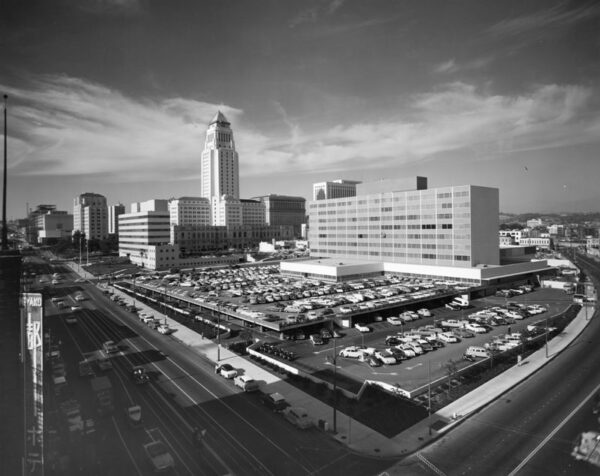
Designed by Welton Becket & Associates and J. E. Stanton, Parker Center opened in 1955 as the Police Facilities Building.
On March 24, 2017 the Los Angeles City Council voted in support of a plan to build a new, 27-story tower for City employees at the current site of Parker Center. This vote paved the way for the destruction of the Modernist former police headquarters built in 1955.
In the Summer of 2019, the City of Los Angeles demolished Parker Center. The site remains empty today.
Background
Parker Center was previously threatened with demolition for a new police facilities building in the early 2000s before an alternate site was found. Since then, appreciation for the building’s historic and architectural significance had become more firmly established and its mid-century modern architecture recognized.
The former LAPD headquarters in downtown’s Civic Center stood mostly vacant since the LAPD moved to its new headquarters in 2009. The public process for deciding what to do with it did not begin until 2012, when the City’s Bureau of Engineering (BOE) released an initial study of ways to provide office space for nearly 5,500 City staff near City Hall. In that study, and ever since, the BOE continued to advocate for Parker Center’s demolition.
In early September 2013, the City of Los Angeles released a Draft Environmental Impact Report (DEIR) for a project called the “Los Angeles Street Civic Building Project.” At that time, the DEIR evaluated three options for the Parker Center property: 1) rehabilitation of the 1955 building; 2) partial demolition, rehabilitation and addition to the building; and 3) full demolition and construction of a new building.
Under all three options, the City’s stated project goals were to house city staff at this central location (those currently located elsewhere throughout the city), address the need for approximately 1.1 million square feet of office space, and provide greater connectivity and services to adjacent Little Tokyo. The City states that 3,865 employees are currently off-site and a project objective is to locate City staff closer to City Hall.
In June 2014, through the release of the Final Environmental Impact Report (FEIR), the BOE announced its preference for the third option, B3, calling for the complete demolition of Parker Center and building in its place one or two towers that would be up to 27-stories and 450-feet in height. At an estimated cost of $475 million, this project would have provided a net of 588,240 square feet and would have housed 2,945 employees.
B2, the second option provided by the City — and what the Conservancy suggested has the best opportunity for a “win-win” outcome — would have retained and rehabilitated the main portion of Parker Center. It called for the addition of an 11-story building to the rear and 200-feet in height. At an estimated cost of $325 million, this option would have provided a net of 354,499 square feet and would have housed 1,775 employees.
About This Place
About This Place
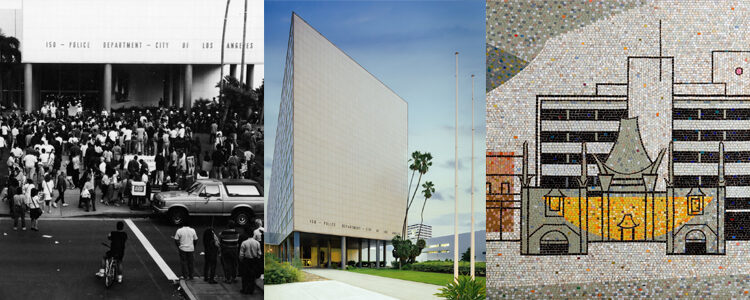
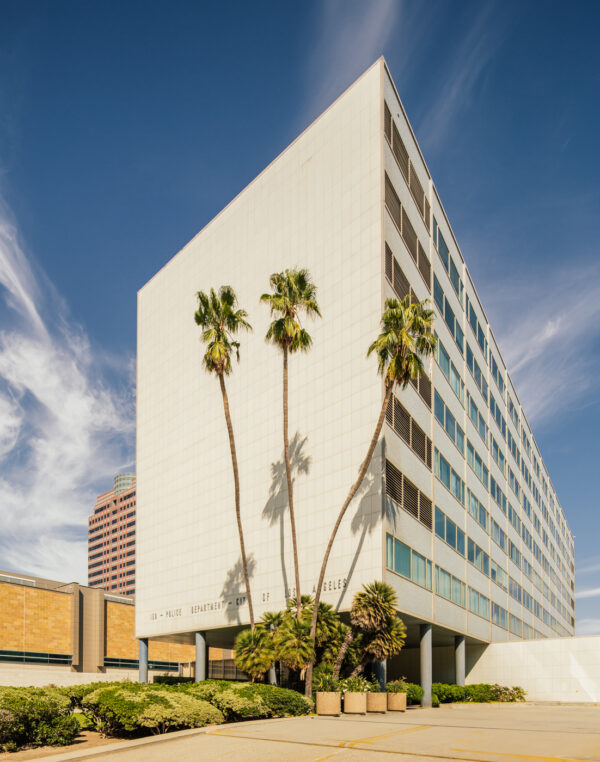
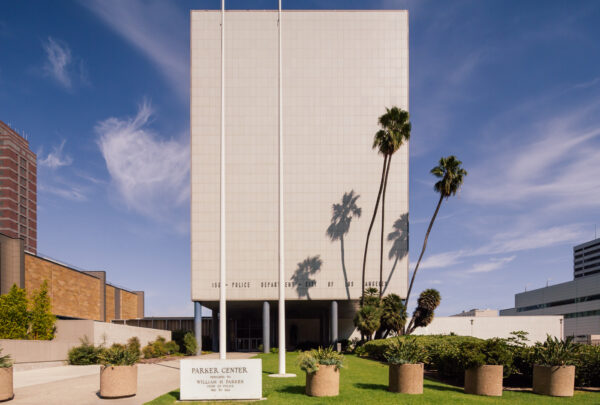
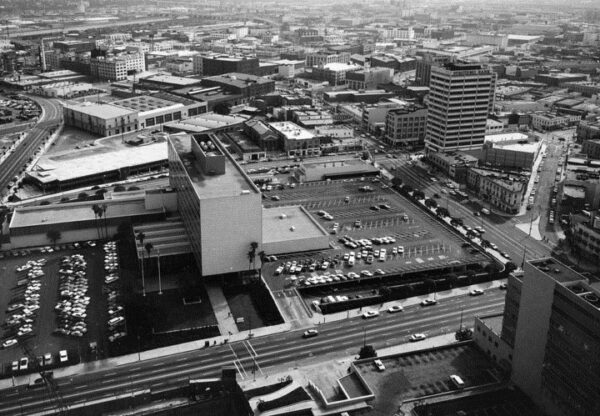
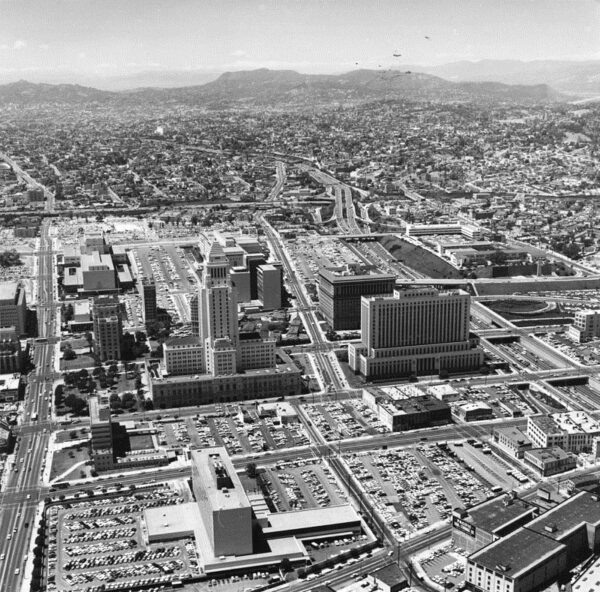
The eight-story, International Style building, with integrated art and landscaping, was a significant postwar addition to the Los Angeles Civic Center. It featured contrasting, rectilinear volumes, most apparent through its rectangular tower of administrative offices set atop a one-story base housing an administrative wing to the south and an auditorium to the north.
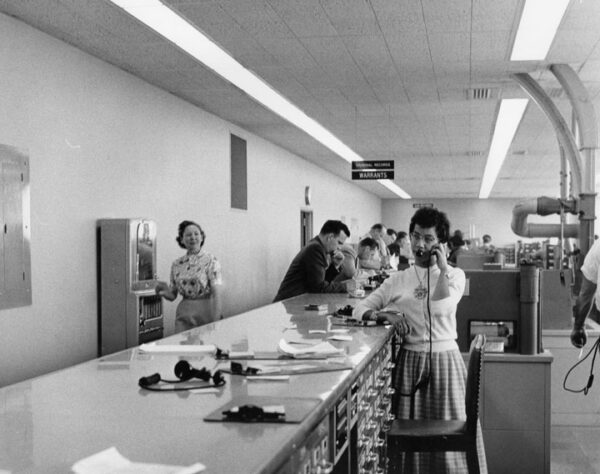
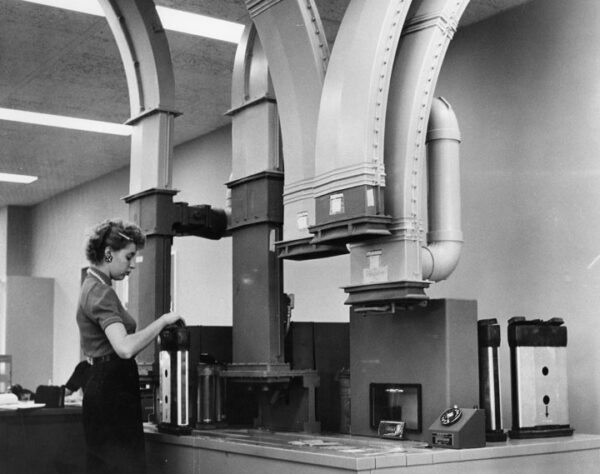
Built at a cost of $6,142,548, Parker Center was considered a state-of-the-art crime-fighting facility and one of the first centralized police buildings in the nation. Some special features included a criminology lab, a lineup auditorium with specialized lighting, a traffic map room, and a communications center.
“Ultramodern is all respects, the new eight-floor Los Angeles Police Building makes available to the city’s police department the most scientific building ever used by a law-enforcement group.”
Popular Mechanics, July 1956
The Integrated Design of Parker Center
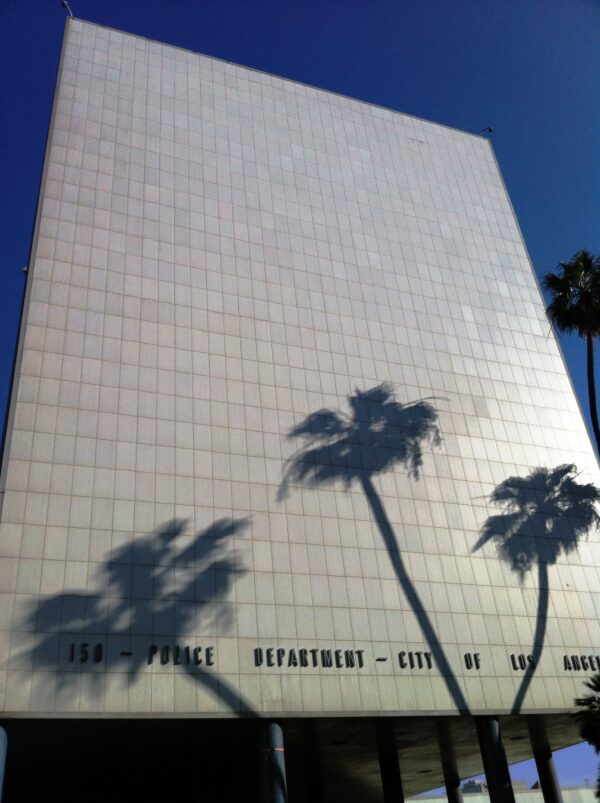
The two-story jail portion of the building also extended north from the tower. Horizontal bands of windows alternating with mosaic tiles dominated the north and south elevations of the tower, which featured windowless west (main) and east elevations clad in ceramic veneer panels. Twelve delicate pilotis (isolated columns) clad in blue mosaic tile supported the mass of the tower extending over the main entrance plaza at Los Angeles Street. The building’s original design remained highly intact until demolition.
Parker Center included two integrated, site-specific art pieces as part of the original design: the bronze sculpture “The Family Group” by artist Bernard J. Rosenthal on the building’s exterior and the expansive mosaic “Theme Mural of Los Angeles” by artist Joseph Young on the interior; both were original to the building. The “Theme Mural of Los Angeles” depicted a stylized composition of images representing the Los Angeles cityscape, including such iconic landmarks as Los Angeles City Hall, Griffith Observatory, and Grauman’s Chinese Theatre.
Parker Center’s innovative design integrated virtually all departments into a single facility, earning the building critical acclaim as a model for modernizing the police force. Parker Center influenced the design of other central police buildings that followed nationwide.
Chief William H. Parker
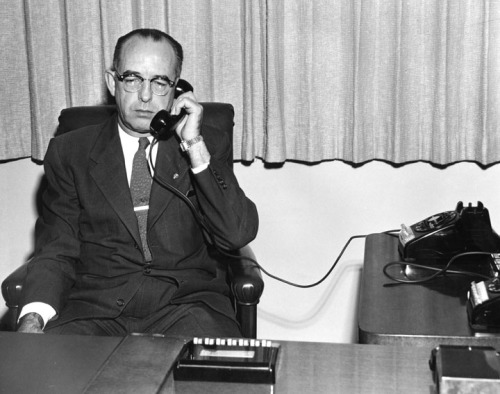
The history of Parker Center is rich and complex. Originally known as the Police Facilities Building, the building was posthumously named for Chief William H. Parker in 1966, who served as Chief of Police at the Los Angeles Police Department from 1950 to 1966. Parker was one of the most distinguished—and controversial—police chiefs in Los Angeles history.
While Chief Parker’s legacy has been controversial particularly in African-American and Latino communities, he is associated with reducing corruption in the police department and developing administrative concepts that have since become standard procedures.
The Cultural Impact of Parker Center
Parker Center became a symbol of the police department in Los Angeles, notably for its guest starring role and backdrop to the popular television show Dragnet. The show is considered one of the most famous and influential police procedural dramas, made so in part by its leading character Sergeant Joe Friday and his stoic, matter-of-fact approach to police work. Parker Center opened during the television series, which initially ran from 1952-59 and was revived for a second run between 1967-70. The series was created and produced by Jack Webb, who also starred as Sergeant Joe Friday.
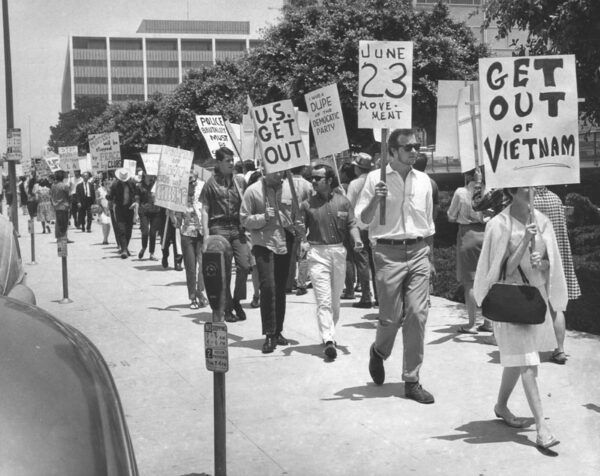
The building has also been associated with some of the city’s most challenging and significant historical events, with Vietnam War era marches in front of the building, crowds gathering there following the Los Angeles riots of April 1992, and again in October 2000 with a coalition of 1,000 protesters as part of the October 22nd Coalition to Stop Police Brutality.
Our Position
Parker Center was an important historic place in Downtown Los Angeles, individually and as a part of the Civic Center Historic District, a key component to the 1947 Civic Center Master Plan. The Conservancy made all attempts to stop its demolition, but did not prevail.
Preservation Would Have Been More Cost Effective than Demolition and New Construction
Based on a convening by the Conservancy of a panel of preservation experts (comprised of highly experienced developers, architects, cost estimator, and seismic engineer), we strongly believed the reuse of Parker Center could have resulted in a savings of nearly $50 million as opposed to new construction.
This directly contradicted claims made by the City stating preservation will be $107 million more (as part of a preservation alternative known as “B4”) than new construction.
Of the three original alternatives considered by the City (as part of the environmental review process), only alternatives B1 (rehabilitation) and B2 (rehabilitation, partial demolition and new addition) had the greatest potential for complying with the Standards and avoiding adverse impacts, while maintaining Parker Center as an eligible historic resource. Alternative B3 — the preferred project — called for the complete demolition and redevelopment of the Parker Center site.
A fourth alternative known as Alternative B4 was studied outside of the environmental review process, and calls for a larger addition to Parker Center. We strongly believed cost estimates were severely inflated by the City, whereas an independent review by a panel of preservation experts instead concludes there is a savings of nearly $50 million. This directly contradicted claims made by the City stating preservation will be $107 million more for Alternative B4.
Historic-Cultural Monument Nomination
In 2014, the Cultural Heritage Commission initiated designation of Parker Center as a Historic-Cultural Monument. The Conservancy spoke in favor of the Cultural Heritage Commission‘s Historic-Cultural Monument nomination at hearings in November 2014, January 2015, and May 2015.
While separate from the redevelopment project, the HCM designation would have protected Parker Center from imminent demolition, as well as from preemptive demolition if the redevelopment project doesn’t move forward.
On February 7, 2017, the Los Angeles City Council’s Planning and Land Use Management (PLUM) Committee voted unanimously against recommending the Historic-Cultural Monument designation of Parker Center.
Related Links
Schematics for Alternative B4, Bureau of Engineering, City of Los Angeles, August 2016
Final Environmental Impact Report (FEIR), June 2014
Conservancy Comments on Draft Environmental Impact Report (DEIR), Parker Center, October 21, 2013
Conservancy Comments on Notice of Preparation (NOP), Parker Center, June 15, 2012
“Built by Becket” tour brochure, Los Angeles Conservancy’s Modern Committee, 2003
Little Tokyo Historical Society Comments to Mayor Garcetti, September 16, 2014
Docomomo-SoCal Letter of Support to Councilmember Huizar and Mayor Garcetti, April 15, 2015
Reusing Parker Center: Fiscally Responsible Stewardship, L.A. Conservancy, January 12, 2017
Conservancy Comments, Chatten-Brown & Carstens LLP, January 25, 2017