Place
Peabody-Werden House
Active
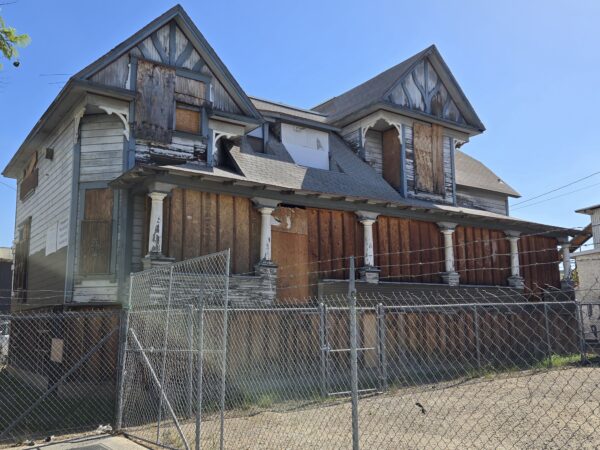
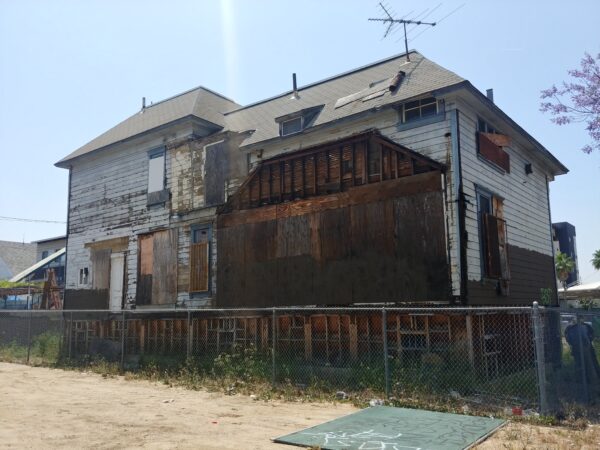
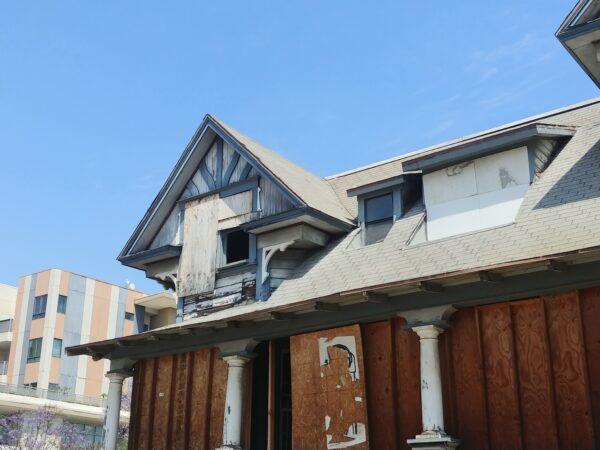
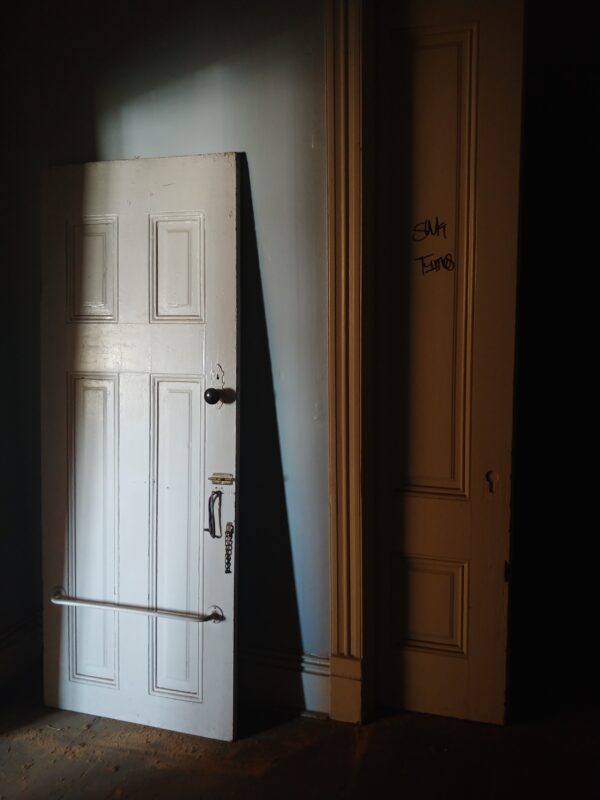
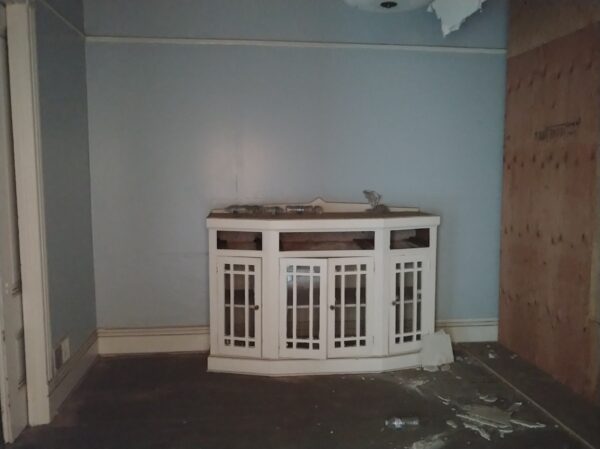
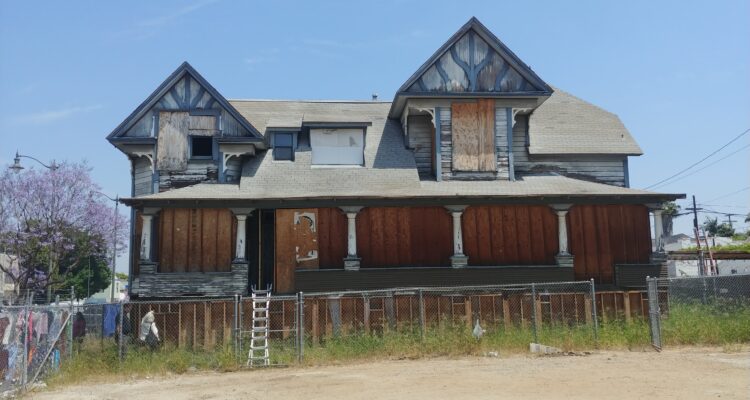
Moved in 2016 to avoid its demolition, this 1890s Queen Anne residence has been vacant, boarded up, and facing ten years of mounting deferred maintenance.
Place Details
Address
Architect
Neighborhood
Year
Style
Decade
Designation
Property Type
Government Officials
Community
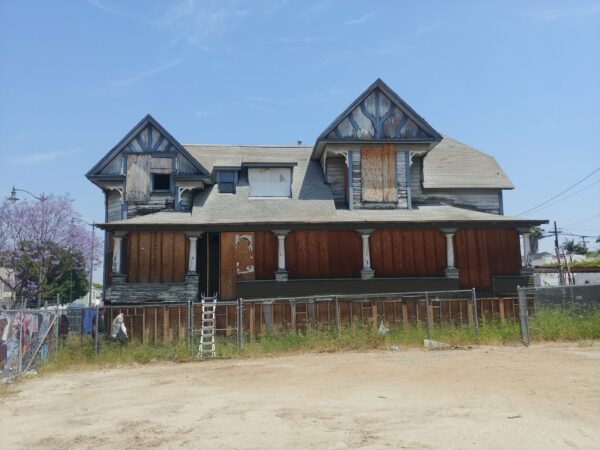
Photo By Andrew Salimian/L.A. Conservancy
Overview
Despite promises by East LA Community Corporation (ELACC) to rehabilitate the Peabody-Werden House as a community center for their Los Lirios housing development, the historic home has remained vacant, boarded up, and facing a decade of mounting deferred maintenance. A proposal now under discussion would move the house out of Boyle Heights to the Garvanza neighborhood for rehabilitation as market-rate housing.
About This Place
About This Place
Built in c. 1894, the Peabody-Werden House is one of the oldest and few remaining examples of a turn-of-the-century duplex residential property designed in the Queen Anne style with some Colonial Revival details. According to Angels Walk LA, the Peabody-Werden House was named after two of its early residents, Josiah Peabody – a journalist and business manager at the Los Angeles Times – and William Werden – a bookkeeper at the South Refining Company.
The house was found to be individually eligible for listing on the National Register of Historic Places in 2001 as part of a historic resources survey for the Los Angeles Metro Authority’s Los Angeles Eastside Corridor Environmental Impact Report (EIR). Through the Section 106 process, it was subsequently placed on the California Register of Historical Resources. The historic house is currently owned by East LA Community Corporation (ELACC) through a ground lease, though the land is owned by Metro.
In 2016, architecture firm Page & Turnbull was hired to study the feasibility of relocating the Peabody House and then was further retained to prepare permit drawings to relocate the house. ELACC secured city permits and installed a permanent foundation on the Metro site for the house to be placed on. The house was moved intact on June 30, 2016, following removal of non-contributing additions to the rear of the property.
The relocation of the Peabody House was required as part of ELACC’s Cielito Lindo affordable housing development. Future rehabilitation and reuse of the Peabody House was to occur as part of a separate development, the 1st/Soto Joint Development project (later named Los Lirios), which was being developed by ELACC in partnership with Metro and was then in its Entitlements Phase. At some point, the plan to rehabilitate the Peabody House as a community amenity for the Los Lirios project was abandoned by ELACC.
In 2024, ELACC issued a Request for Proposals (RFP) to seek a partner to rehabilitate the Peabody-Werden House and potentially occupy the building. ELACC convened a stakeholders meeting in October 2026 to provide a community update regarding the future of the Peabody House, review the results of the RFP, and hear ideas and feedback.
The Conservancy attended this meeting and learned that no feasible RFP proposals had been submitted. ELACC shared they had recently been in conversation with a private developer with experience restoring historic homes in Los Angeles, who is interested in relocating the house to the Garvanza neighborhood and restoring it at his own expense for use as market rate housing. If this plan is pursued, ELACC will need to raise $300,000 to pay for the relocation to Garvanza.
Our Position
Keeping the Peabody-Werden House in Boyle Heights is about more than preserving an old house. It’s about protecting neighborhood character and identity in a community whose architectural heritage is largely underrecognized and unprotected. The Conservancy’s position is:
- Prioritize rehabilitation and adaptive reuse of the structure at its current location to preserve its historical and neighborhood context.
- If that proves infeasible, secure a receiving site within Boyle Heights to keep the asset within the neighborhood.
- Consider relocation outside of Boyle Heights as a last resort, only after prior alternatives have been meaningfully evaluated.